
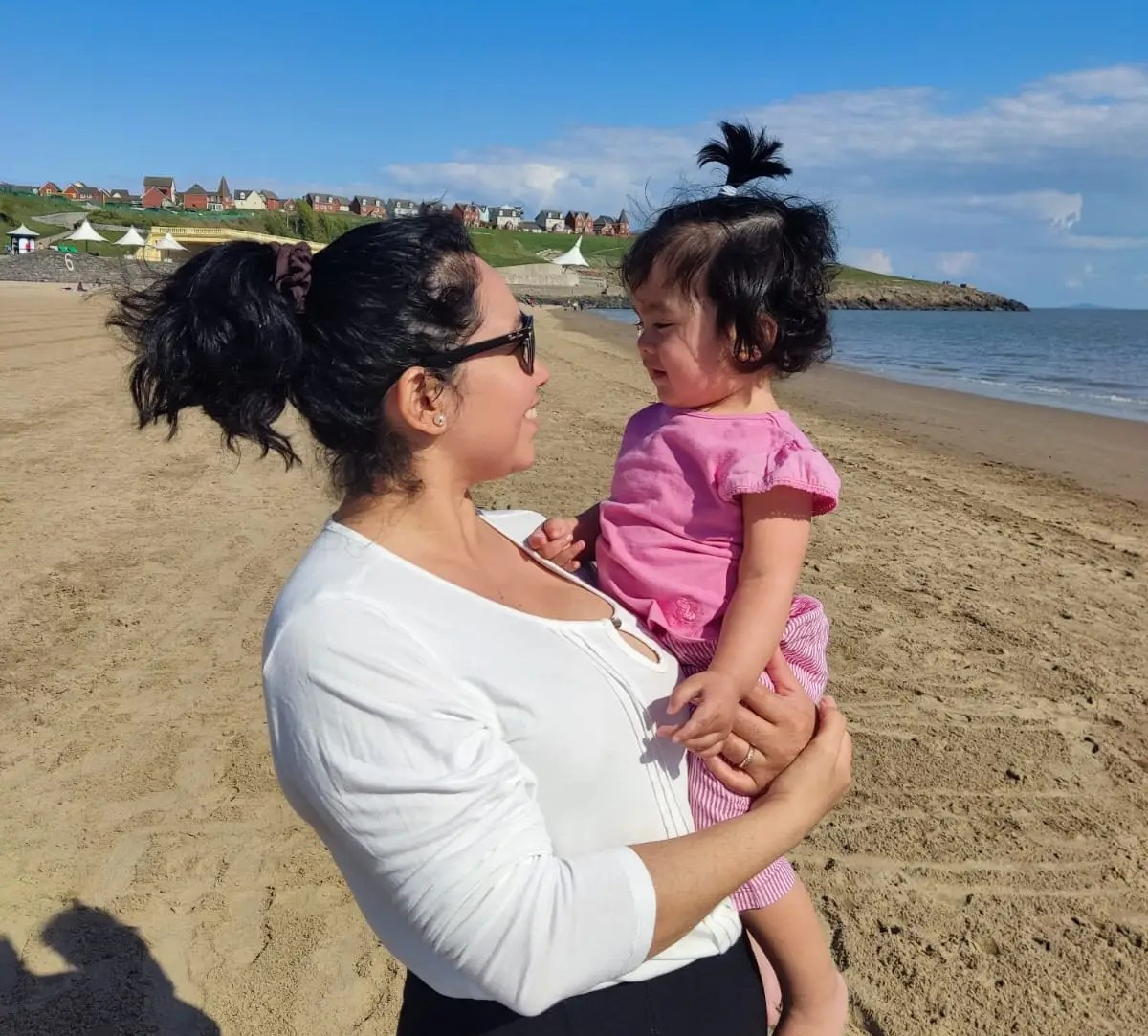
The inspiring story of how Cenia faced fear, uncertainty, adversity and subsequent mental health difficulties with determination and hope.
Cenia, Angel and their three-year-old daughter are a young family from El Salvador. Cenia and Angel came to the UK in 2020 having lived in fear in their home country due to worsening gang crime and violence. Gang members had forced their way into the couple’s home on numerous occasions, and they felt unsafe and constantly scared so they decided to start a new life in a safer and more secure environment.
Cenia recalls that, “we wanted to start a new life in the UK. We didn’t speak English but thought I would be OK. However, we didn’t know how difficult it would be”. When they first arrived during lockdown, they were placed in a hotel in Cardiff. “This was the most difficult time of our journey. We felt lonely and didn’t know how to move forward”. They were then housed in a studio flat in Reading where they stayed for two years, during which Cenia became pregnant, which was unplanned. Cenia explains that she didn’t know how to manage such a big challenge in an unfamiliar country without knowing the language. “I felt very low and worried about how I could manage the situation. But we had to make a decision on whether we made this new opportunity work; it was not an option to return to our country due to the violence and fear.”
Cenia tells her story…
We felt if we were patient we could eventually get permission to work and make a life for ourselves. But we did not expect such a long three to four year wait before we’d be entitled to work and be able to make a life for ourselves. During this time we felt trapped and unable to help ourselves. When my daughter was born it gave me the motivation to learn to speak English to support my daughter as best as I could. I started to learn anything I could and went to as many classes as possible. When my English started to improve, it gave me hope.
But [before that,] having my daughter and not speaking English came with difficulties. I was so scared when my child got jaundice, I thought she would die because I didn’t understand what was wrong with her and I didn’t understand the doctors. We were so concerned we tried to phone an ambulance but they couldn’t understand us. We then tried to call for a taxi to take us to the hospital but the taxi didn’t understand us either and hung up. I made the decision then that I couldn’t live like this, I had to learn English to take care of my daughter to the best of my ability. When I couldn’t communicate in English, it felt so hard. It’s like you have no voice, it’s like you are mute and can’t express how you feel and who you are. Even going to the supermarket is a struggle. The man asks you if you need a bag, but you can’t understand it or communicate what you need. Let alone when you need help for more important things. You can’t say hello to the friendly person in the street, you can’t make friends.

I then found myself suffering from postnatal depression. I didn’t understand why I felt so low. I think loneliness and isolation had a significant part to play in my depression and I believe it’s one of the worst feelings in the human experience – you can lose your will to live. The only thing I had to do was ask for help. I was put in touch with an organisation called Homestart who helped me so much. They gave me eight sessions to learn about postnatal depression and it really helped me to understand depression and my life and myself more.
When we were moved to Hayling Island, I asked God to help me as I felt myself slipping backwards. After three years we were still waiting as asylum seekers with no permission to work or ability do anything to support ourselves to move forward. I went to the GP and asked for help again. I tried to be positive again and find the strength.
In total we were moved to nine different hotels following our arrival in the UK. Now that we have been granted asylum and have leave to remain in the UK, we are staying in a homeless hostel. It can be scary sometimes, with those around us misusing drink and drugs and we have our daughter to protect but there is no other accommodation and we have been told to look for privately rented accommodation.
When I arrived in the Chichester area I didn’t know anyone. A lady told me about Sanctuary in Chichester [SiC], a charity that supports refugees and asylum seekers. I searched the internet and got in contact with the charity. I was invited to the weekly drop-in, which exceeded my expectations. The volunteers there were so friendly and made me feel welcome and part of the community. I felt like I wasn’t just an asylum seeker; someone that is often cast in a bad light in the media. It made me feel like I was part of this community without feeling judged.
I was then visited by Kerry who helped me create a Pathways to Independence plan. It was a personal plan which I felt was focused on me. I felt important, like someone was investing time to help me. The moment I did this with Kerry I felt a sense of self-worth, I was impressed by the support and the plan. It focused on the next six months and goals that I could achieve and that were based around my aspirations and my passion to be a teacher. I think I had been starting to feel ‘comfortable’ – I had started thinking ‘OK, I can be safe, take care of my daughter and perhaps just work as a cleaner’. I had started to lose my ambition. In my home country I had been studying to become a teacher. Then I came here and I was not expecting to achieve my dream. I never imagined that I could still be a teacher. Kerry has helped me understand how to access opportunities and how to plan a route to achieve my full potential and be a productive member of the community.

SiC supported me to start a 12-week bridging course at the University of Chichester in February 2024, to enable access to education at degree level and to help me familiarise myself with studying and education in the UK. This has increased my confidence in learning and academic study. I have been connected with volunteering opportunities by Kerry, to improve my employability skills, and she suggested that my next step is to get a job as a Teaching Assistant. Now I think I can achieve my dream.
I continue to take care of my mental health and recently started Mind sessions with Lydiia offered by SiC. This has enabled me to understand myself and try to take all opportunities and learn as much as possible to help me through difficult times. It has supported me to address my loneliness and isolation and given me the confidence to take opportunities to find new friends.
I’m still learning but I don’t feel afraid anymore. You don’t need to feel under confident, you just need to think about what you can achieve if you put your mind to it. If you can have a positive perspective and use opportunities to learn, you can improve your life and your situation. I now have a friend who is a neighbour and we can sometimes spend the whole day together. She came to the UK when she was young. She told me she likes to speak with me. I feel so happy that I can communicate in English with those around me now.
My advice to others in my position is: don’t be afraid, don’t be ashamed and don’t stay in your comfort zone. Find people that can help you, people that are part of the community, and take the opportunities that are offered to you. If you are living in England, you have to learn English if you want to be part of the community, learn about British culture and it helps you to understand about English people, otherwise you will always be isolated in a way.
SiC have helped me so much. I have faith that things will get better. Today, I feel so happy, I have the opportunity to be the best person I can be. I felt like an asylum seeker before; now I feel like Cenia – I can fit in and be part of and give back to the community.
– Kerry Foster, Pathways to Independence (PTI) Manager
Kerry says; “I am so very proud and in admiration of Cenia and her partner and so many other refugees and asylum seekers whose courage, determination, resilience and faith keeps them going through unimaginable circumstances – not only prior to arriving in the UK but then the challenges faced upon arriving here and the impact this can have on mental health and wellbeing. Cenia has taken every opportunity that has been offered to her and it is paying off. She has achieved so much and in the last 6 months has reached all goals set on her PTI plan with flying colours. Most importantly, she has reached out and asked for support when she needed it. I hope her story will encourage and inspire others to ask for help, to not be ashamed or embarrassed about needing support, as everyone at some point in their lives need it. I also hope her experiences will encourage others to grab opportunities with both hands and to understand the importance of having direction and focus, with some achievable goals no matter how small or big. Cenia is now well on her way to realising her dream.“